
How Instagram Delivers Infinite Reels So Smoothly (System Design Breakdown)
You open Instagram.
A reel starts instantly.
You swipe.
Another one plays — no spinner, no loading screen.
You scroll 50… 80… 100 reels.
Still smooth. No buffering. No visible delay.
And somehow, it keeps getting more relevant.
How does Instagram make infinite scroll feel instant — and how does it always know what to show next?
Let’s break it down like engineers.
The 3 Core Engineering Problems
At massive scale, Instagram must solve:
- Infinite scroll without latency
- Instant video playback globally
- Real-time personalized recommendations
Each of these is a separate distributed system.
Infinite Scroll: Pagination Done Right
What Is Pagination?
Pagination means fetching data in small chunks instead of loading everything at once.
Instead of loading thousands of reels in one request, the app fetches 10–20 reels per API call.
This reduces database load, network overhead, and memory usage.
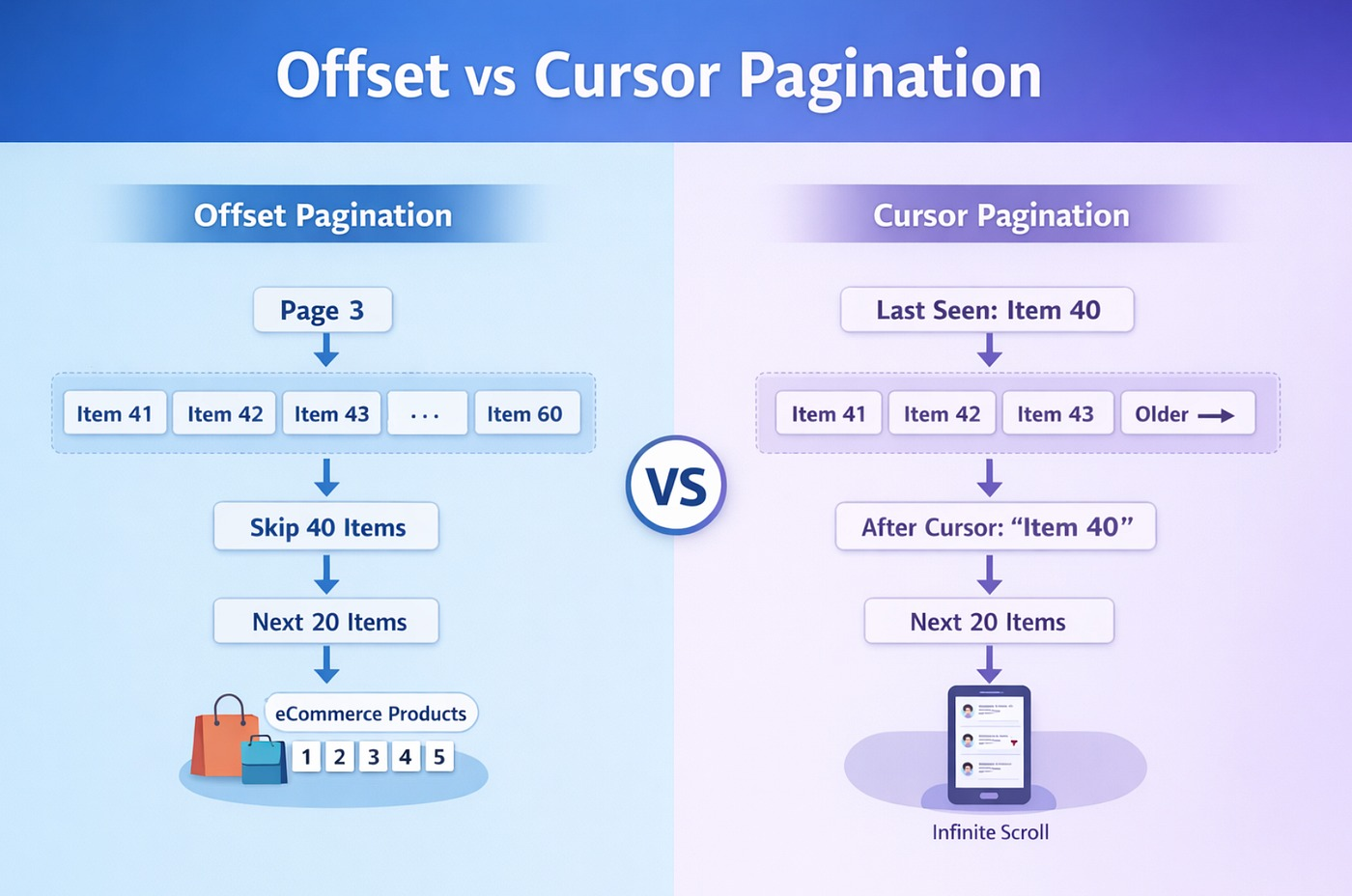
Why Offset Pagination Fails
Bad approach:
SELECT * FROM reels LIMIT 10 OFFSET 10000;Problem: Database must scan and skip 10,000 rows. Performance degrades as offset grows. Not scalable at billions of rows.
Cursor-Based Pagination (The Scalable Way)
Instead of skipping rows, the server says: “Give me results after this ID.”
GET /feed?cursor=abc123The cursor can be a last reel ID, ranking token, or timestamp.
Why it works:
- Uses indexed lookups
- Avoids row scanning
- Works well with distributed databases
- Stable even when new content is added
How Instagram Makes It Feel Instant
- App requests 15 reels
- Server returns reels +
next_cursor - While you’re watching Reel #3, app prefetches the next batch
- Videos are buffered client-side
By the time you swipe… the next reel is already loaded.
Infinite Scroll Request Flow
Flow: User → Mobile App → API Gateway → Feed Service → Redis Cache → Database
Most requests are served from cache, not the database. That’s the real performance booster.
Video Delivery: How CDN Makes It Fast
Video is heavy. If every reel were streamed from a single central server, latency would be high, bandwidth costs would explode, and global users would suffer.
What Is a CDN?
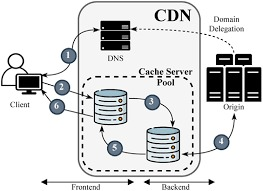
A Content Delivery Network (CDN) is a globally distributed network of servers.
Instead of storing video in one location, it replicates content across edge servers worldwide. Users fetch from the nearest server — distance decreases, latency decreases.
Chunk-Based Streaming
Instagram does NOT download the entire video first.
Instead:
- Video is split into small chunks (2–4 seconds)
- First chunk loads → playback starts immediately
- Remaining chunks load in background
This is why reels start instantly.
Adaptive Bitrate Streaming
Network slow? Video quality automatically lowers. Network fast? Quality increases. No manual refresh required.
CDN-Based Delivery Flow
Flow: User → Nearest CDN Edge → (If miss) → Origin Server → Distributed Storage
Most of the time, video is already cached at the edge. So playback feels instant.
Recommendation System: Why It Knows What You Like
Infinite scroll is useless without relevance. So how does Instagram decide what to show?
Step 1: Collect Signals
Every action becomes data: watch time, replays, likes, shares, comments, skips.
Watch time is especially powerful. If you watch fully → strong positive signal.
Step 2: Event Streaming (Kafka-Style Pipelines)
You cannot directly write millions of interactions into databases synchronously.
Instead: User Activity → Event Stream (Kafka-style system)
- Events are appended to a distributed log
- Multiple consumers process them asynchronously
- Systems stay decoupled
Benefits: High throughput, fault tolerance, replay capability. If a processor fails? Events remain stored. Nothing is lost.
Step 3: Feature Extraction + Ranking
Events update user interest vectors, creator affinity, and category preferences. These features go into a ranking model that scores thousands of candidate reels. Top-ranked reels form your next batch.
Flow: User Activity → Event Stream → Feature Store → ML Ranking Model → Ranked Feed → Cache
Heavy computation is done offline. Real-time layer adjusts ranking quickly. This balance keeps it both fast and accurate.
Scaling Realities: Surviving Billions of Users
Sharding: Splitting the Database
Sharding means splitting a large database into smaller independent pieces.
const shard = hash(user_id) % N;This enables horizontal scaling, parallel processing, and reduced load per node. When you open Instagram, the system directly queries the shard that contains your data — no global scanning.
Kafka-Style Event Streaming at Scale
Millions of events per second flow through the system. With event streaming:
- Writes are fast (append-only)
- Processing is asynchronous
- Multiple systems consume the same data
This powers real-time personalization.
Circuit Breaker Pattern: Preventing System Collapse
At large scale, failure is normal. Without protection: all requests retry → system overloads → cascading failure begins.
With circuit breaker:
- System detects high failure rate
- Stops sending traffic to failing service
- Falls back to cached or generic feed
States: Closed (normal) → Open (blocked) → Half-open (testing recovery)
This ensures the app degrades gracefully instead of crashing completely.
Why It Feels Instant
When you swipe:
- Feed is already prefetched
- Videos are cached at CDN edge
- Rankings were precomputed
- Events are processed asynchronously
- Data is sharded for fast access
- Circuit breakers protect failing components
Nothing major happens at swipe time. Everything was prepared earlier. That’s the secret.
Key Takeaways
- Cursor-based pagination avoids expensive DB scans
- Prefetching + buffering hide latency
- CDNs reduce global network delay
- Chunk streaming enables instant playback
- Kafka-style pipelines enable real-time personalization
- Sharding enables horizontal database scaling
- Circuit breakers prevent cascading failures
Final Thought
Next time you scroll endlessly through reels…
It’s not just a swipe. It’s distributed databases, event streaming systems, CDN edges, ranking models, and failure protection mechanisms working together in perfect sync.
Infinite scroll isn’t magic. It’s distributed systems, caching, and machine learning engineered to feel invisible.
Follow this System Design series if you want to master how real-world products actually work.